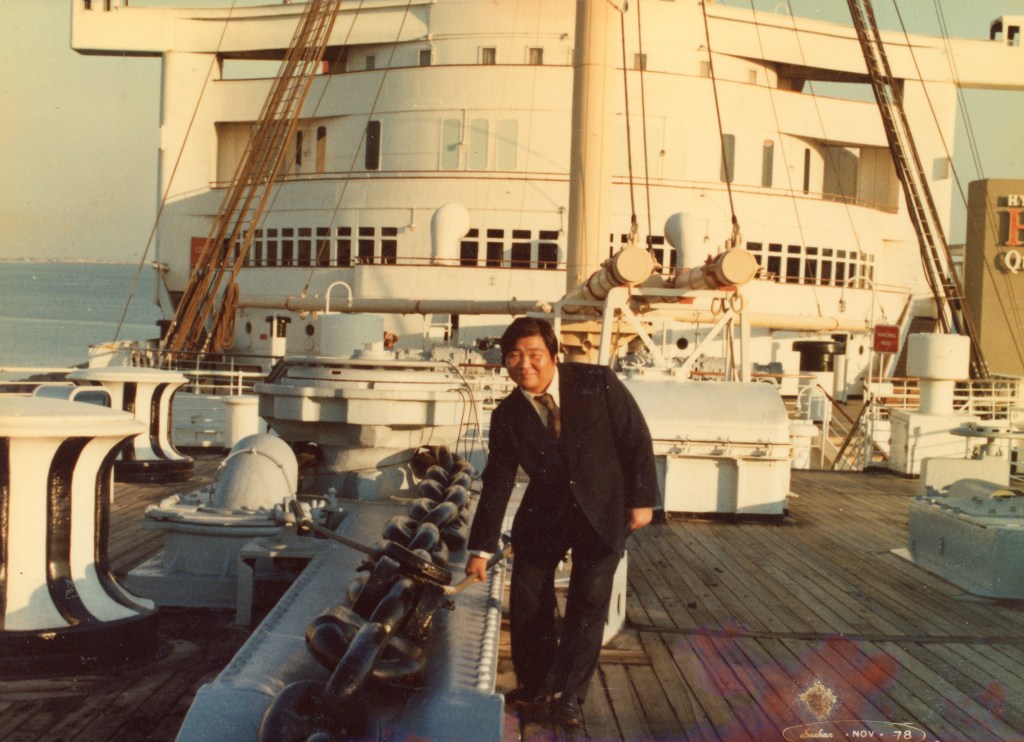
They say even rivers and mountains change in ten years, but there is one thing that has remained unchanged over the twenty years since rivers and mountains have changed twice over.
It is the cherished memories of our daily encounters with Hak-san, deeply held in our hearts. The warm and gentle fragrance of his humanly personality, embracing each person generously. His kind heart that gave water to the thirsty and fed the hungry. And his dignified and charming way with words…
Such precious things remain with us, unchanged, as gentle longings.
Like numerous lives finding rest under the shade of a great tree, my father is remembered by many I have met in this way. This is why many still miss him dearly.
My father especially loved ssireum (Korean wrestling). The beautiful gestures of wrestling, where one grapples face-to-face, sharing sweat, heartbeat, and breath, where strength, passion, and each person’s life struggles are revealed. Isn’t this what our encounters truly aspire to be?
My father particularly cherished the fair and honest nature of ssireum. He lived his life fully embodying the meaning and joy within this sport.
I believe he spent his entire life striving to share that meaning and joy with those who loved and devoted themselves to ssireum alongside him.
He did not keep the benefits of his victories to himself; he always worked to ensure that the benefits returned to all those who strove together with him. He continuously built a community network where no one was excluded, recommending people to suitable places so that everyone could grow and mature together, and helping those struggling with life’s problems to find their way again.
Recently, I watched a video of my father speaking during his lifetime. Even in that video, what he wished for was a world where those who loved and enjoyed ssireum could live together harmoniously.
He aimed to popularize ssireum as a recreational sport so that children could enjoy wrestling wherever they were. He also sought to establish a system where leaders were rewarded for nurturing good athletes, allowing capable wrestlers to enter sponsorship contracts freely through clubs or individually, and creating an environment where professionals and amateurs could coexist. He wanted professionals to be rewarded according to their contributions to ssireum or its association. My father long hoped for ssireum to become an Olympic sport and walked his path with this aspiration.
On May 30th, the 21st <Hak-san Kim Seong-ryul National Ssireum Championship> will be held in Changwon city. I believe the Hak-san Cup is a gift and a meaningful legacy to all those who love ssireum. I look forward to seeing the spirit and intentions my father sought to realize through ssireum unfold anew in the future.
Thank you.
On May 25, 2024
Eldest son, Jong Woo Kim

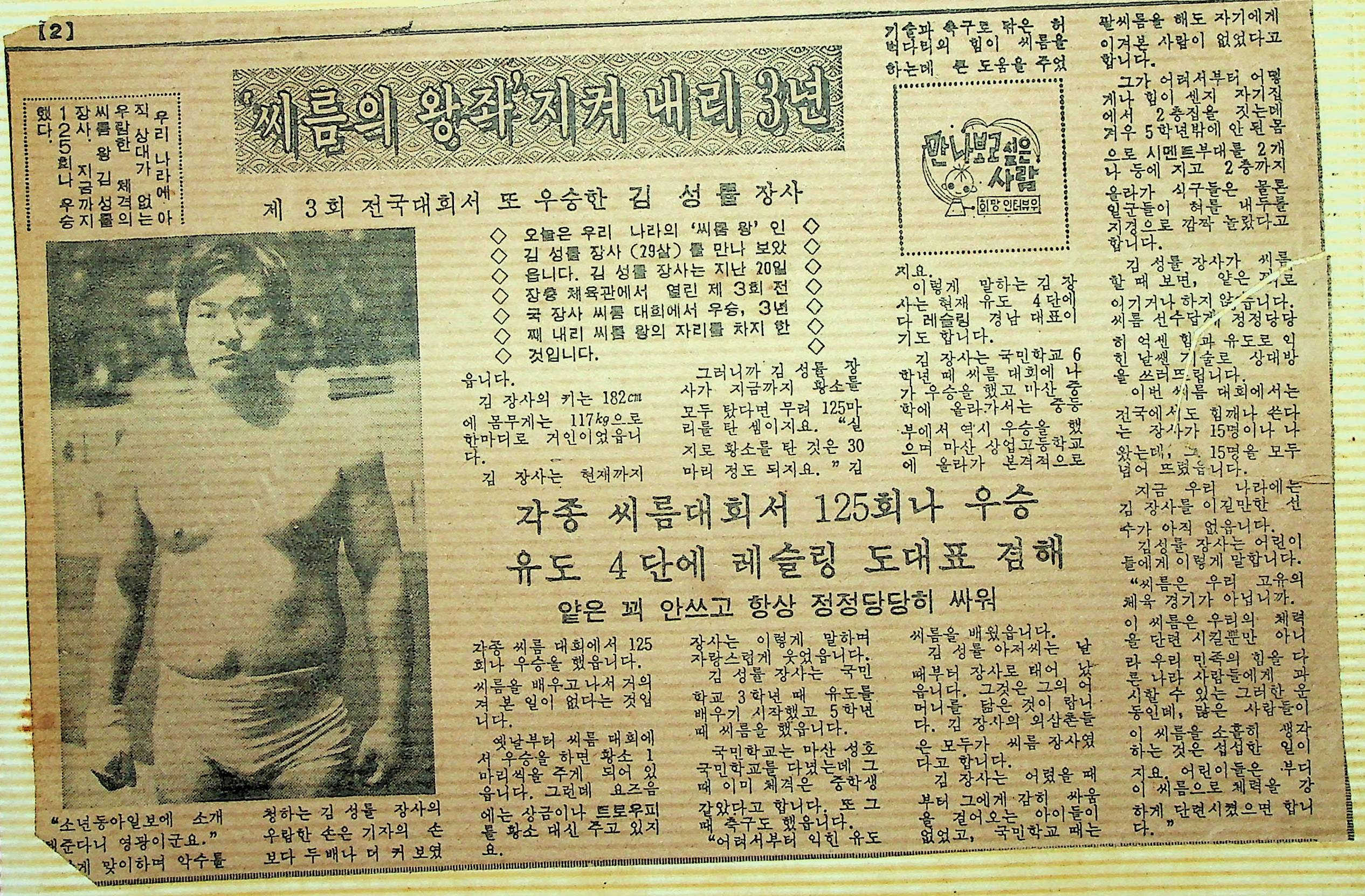
“The Life and Sports Activities of Kim Seong-ryul, the Hero of Modern Ssireum in Korea”
[Translation of a part of the following paper] : “The Life and Sports Activities of Kim Seong-ryul, the Hero of Modern Ssireum” The Korean Journal of History for Physical Education, Sport, and Dance 2022, 27(2). Lee, Ka-Ram(Gyeongsang National Univ., Professor) & Moon, Seong-Guk (Gyeongsang National Univ., Graduate Student).
1. The Life of Kim Seong-ryul
Kim Seong-ryul was born on March 4, 1948, at 108 Changdong, Masan City, Gyeongsangnam-do. He was the fifth child among four brothers and two sisters, born to father Kim Hak-bong and mother Cheon Gi-chul. His childhood was not without challenges, as his father passed away when he was only three years old. Despite this early loss, his mother, a strong and dedicated woman, managed to raise her six children alone after her husband’s premature death. She supported the family by running a fabric store.
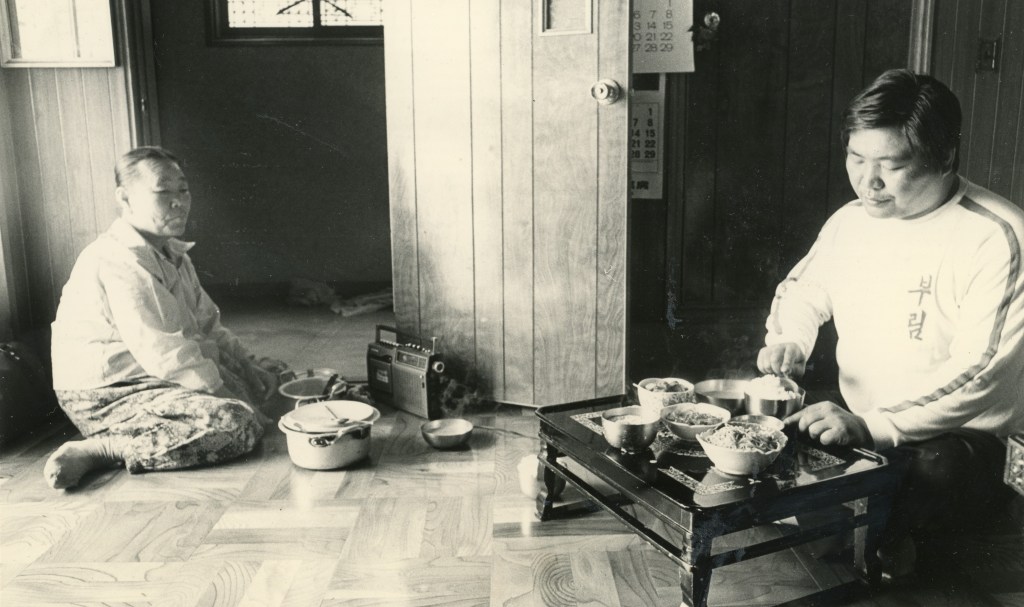
His father left behind a legacy of physical prowess, having been skilled in judo and ssireum. This athletic talent was passed down to his sons as a physical inheritance. Particularly, Kim Seong-ryul and his eldest brother, Kim Ki-chang, showed exceptional athletic abilities from a young age. Inspired by his brother, who had taken up judo, Kim Seong-ryul naturally began practicing judo at the age of nine. After enrolling in Masan Seongho Elementary School, he trained seriously in judo, soon becoming unrivaled among his peers in skill.
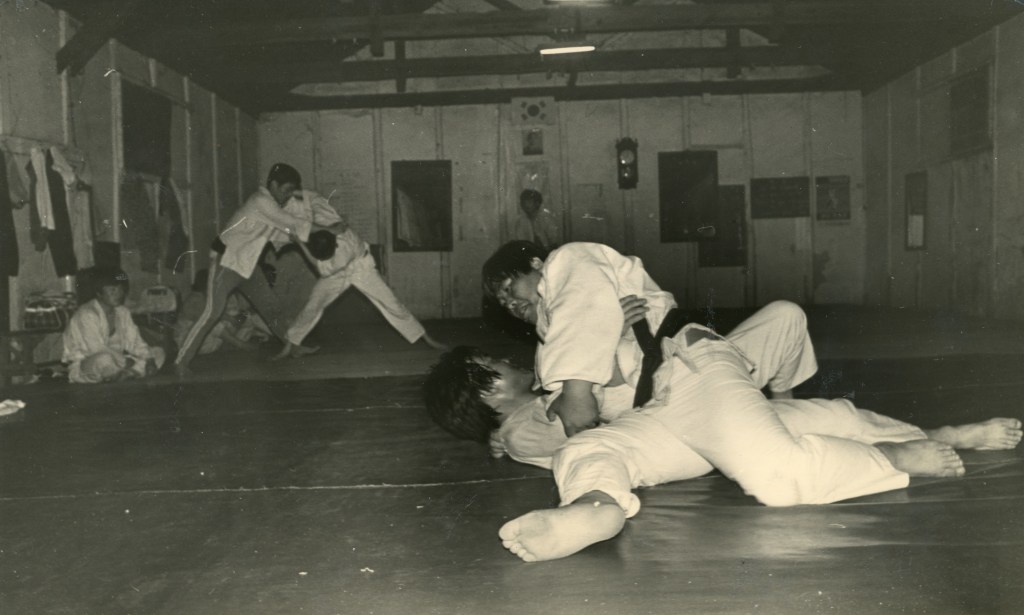
Meanwhile, Kim Seong-ryul also demonstrated potential in ssireum. By chance, he participated in an elementary school ssireum competition and exhibited unexpectedly exceptional skills. It appears that the athletic talent of his father, who was skilled in sports, was fully inherited by Kim Seong-ryul.
From his early years, Kim Seong-ryul was known for his courageous temperament. His brother, Kim Hyo-yul, shared an anecdote that illustrates Kim’s bold nature as a child: “There was a very large dog in the neighborhood, and one day, it broke loose and ran out. When it started to attack, everyone ran away, but Kim Seong-ryul didn’t run. Instead, he faced the dog. Although he got hurt, it showed his remarkable bravery and a warrior-like spirit.”
Kim Seong-ryul was a born competitor. Despite the danger, his decision to bravely confront the large dog rather than flee indicates that he possessed a strong and determined character. He was also physically well-built. During his elementary school years, he was bigger than his peers, often embarrassing older students with his strength and spirited nature. Kim Seong-ryul excelled in various sports, including judo, wrestling, ssireum, soccer, and athletics, demonstrating both the physical and mental foundations necessary for an athlete.
Possessing natural strength and agility, Kim Seong-ryul embarked on the path of an elite athlete starting in middle school. However, he chose soccer over ssireum. He began playing for the soccer team at Masan Middle School and later entered Masan Commercial High School (now Yongma High School) as a soccer scholarship student. Though primarily focused on soccer, he occasionally stepped onto the ssireum sand. With flexibility honed through judo and a strong lower body developed through soccer, Kim Seong-ryul could participate in ssireum matches without special training and still achieve excellent results. Notably, during his middle school years, he won an individual junior division championship in ssireum, which became a decisive factor in his switch from soccer to ssireum. Although he entered high school as a soccer player, he was captivated by the art of ssireum, which involves swiftly overpowering an opponent.
The ssireum team also made an offer to him. After casually entering a competition and easily defeating his opponents, the coach from Masan Commercial High School naturally encouraged him to join the ssireum team. As a result, he decided to join the ssireum team in his first year of high school. The outcome was favorable. Even though he had less than a year of experience in ssireum, in 1967, during his sophomore year, he caused a sensation across the national sand pits. He led Masan Commercial High School to back-to-back national championships, dominating the high school ssireum scene. His crowning achievement came at the 1967 National Grand Champion Ssireum Tournament held in Kimcheon, Gyeongsangbuk-do, sponsored by the chairman of the Republican Party. At this tournament, Kim Seong-ryul staged a major upset by defeating some of the best players of the time, notably overcoming the top wrestler Kim Hak-ryong to win the championship, thereby beginning to make a name for himself nationwide.
After advancing to Kyungnam University, Kim Seong-ryul grew to be an unmatched contender on the adult ssireum stage. His prime coincided with the popular expansion of Korean ssireum. In 1972, the Korean Ssireum Association and KBS jointly hosted the first KBS Cup National Grand Champion Ssireum Tournament. The national broadcast of the event significantly raised public interest in ssireum. The match between Kim Seong-ryul and Park Beom-jo during this time was a highlight, aiding in popularizing the sport.
Kim Seong-ryul, standing 183cm, defeating the towering 203cm Park Beom-jo with his technique, was a pivotal moment that helped elevate ssireum to a national sport. It marked the end of the fragmented era of ssireum and the birth of a modern ssireum hero.
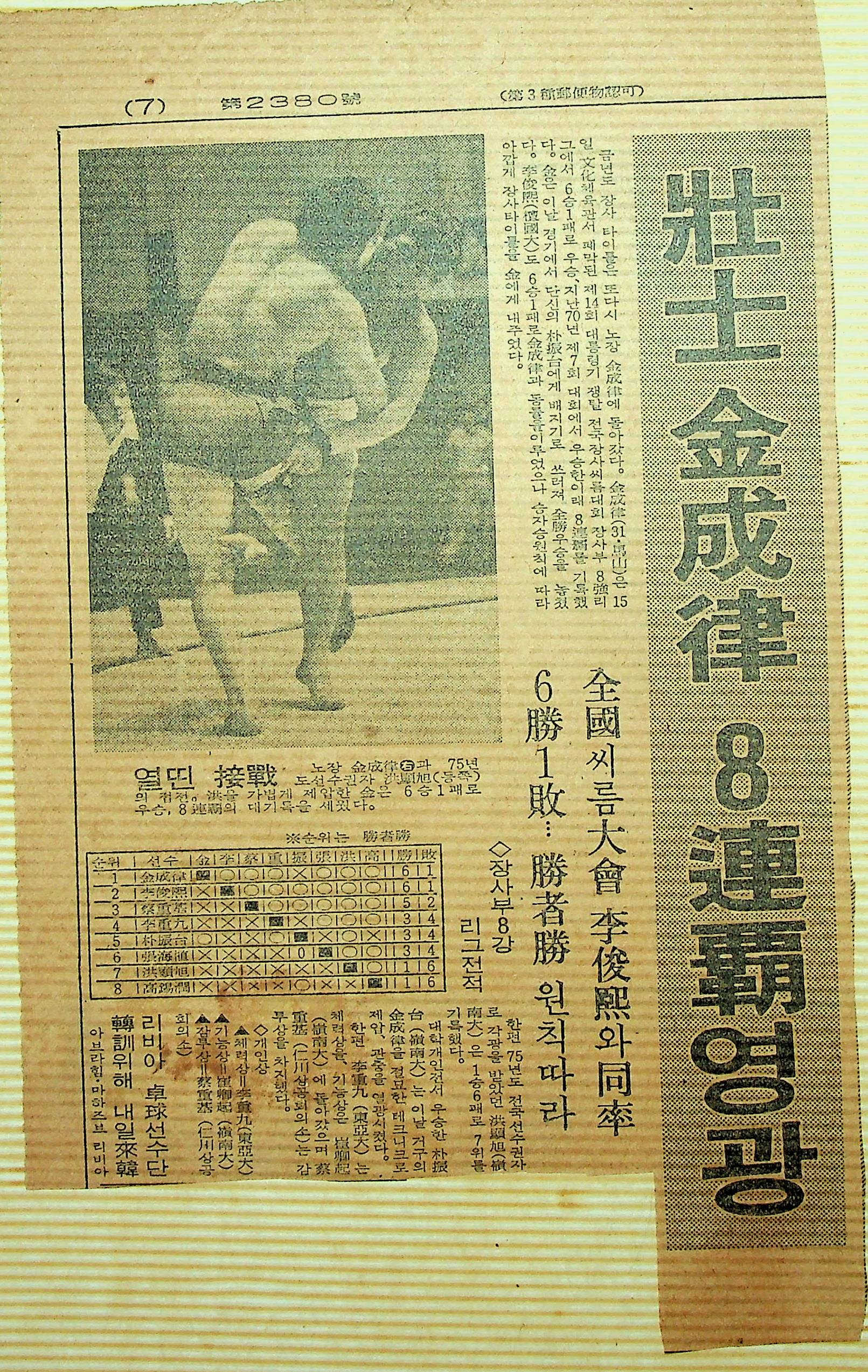
Kim Seong-ryul’s dominance is evident from his track record. For instance, he consistently won the heavyweight division at the President’s Cup National Grand Champion Ssireum Tournament from its 7th iteration in 1970 through the 14th in 1977, securing eight consecutive titles. He also won the first four KBS Cup National Grand Champion Ssireum Tournaments, claimed four victories at the National Ssireum Championship, and won twice at the Chairman’s Cup National Grand Champion Ssireum Tournament. From 1970 to 1977, he was the undisputed champion across all major national ssireum tournaments, earning a permanent claim to the President’s Cup. Additionally, he also competed in wrestling, winning several times in the super heavyweight category at the National Sports Festival. His contributions to sports earned him multiple awards, including the Gyeongsangnam-do Culture Award (1973) and the Gyeongsangnam-do Best Athlete Award.
After retiring, Kim Seong-ryul dedicated his life to the development of Korean ssireum. He served as a professor at Kyungnam University, where he passionately nurtured ssireum athletes in the Masan area. Wrestlers who led Korean ssireum in the 1980s, such as Lee Seung-sam, Lee Man-ki, and Kang Ho-dong, were all mentored under Kim Seong-ryul. His ssireum techniques and philosophy laid a crucial foundation for the advancement of the sport in Korea. Additionally, Kim Seong-ryul took active roles as the vice-president of the Korean Ssireum Association and the chairman of its technical committee, contributing significantly to the promotion and development of ssireum.
However, his life was cut short. On May 25, 2004, he passed away suddenly due to a chronic illness, shortly before the inaugural Hak-san Cup Ssireum Tournament named after him was to be held. Fortunately, the Hak-san Cup Ssireum Tournament continues to be held, annually commemorating his contributions and achievements in the Korean ssireum community. Although Kim Seong-ryul’s life was brief, it was impactful. He initiated a resurgence in the popularity of Korean ssireum, inspiring wrestlers who have continued to play pivotal roles in the sport’s renaissance.
2. Sports Activities of Kim Seong-ryul
2.1. As an Athlete

Kim Seong-ryul was a natural sportsman. He possessed excellent physical attributes and innate athletic abilities, demonstrating potential in various sports from an early age. However, he spent most of his time as a ssireum athlete. His first official entry into a ssireum tournament was in 1962, during his third year of middle school.
The 1962 inaugural National Grand Champion Ssireum Tournament, held in commemoration of the unveiling of the March 15th Memorial Tower, marked the beginning of Kim Seong-ryul’s ssireum career. The result was an unexpected victory. Kim had never formally trained in ssireum, and his school, Masan Middle School, did not even have a ssireum team. So, Kim Seong-ryul was listed as a member of Jungang Middle School because he had to compete under their ssireum team due to the lack of a ssireum department at his own school. His victory at this national tournament became the decisive factor that led him to formally enter the world of ssireum.
Kim Seong-ryul’s inherent qualities were quickly recognized by the ssireum team at Masan Commercial High School, which also facilitated his debut on the sand. Initially active as a soccer player after entering high school, Kim Seong-ryul, weighing 90kg, caught the attention of the ssireum team. Influenced by Kwon Young-sik, a pillar of Masan ssireum, and Kim Seong-su, a senior from Masan Commercial High School’s ssireum team, he officially joined the high school’s ssireum team in his sophomore year and began training professionally. His outstanding talent quickly led to impressive results. From the mid-1960s, he began participating in various regional and national ssireum competitions, making a name for himself.
For instance, in 1965, while still a high school student, Kim Seong-ryul won the national ssireum tournament held in Shinbanchon (Uirim-myeon, Euiryeong), during the Chuseok festival. He defeated notable wrestlers such as Kim Seong-su (Masan), Park Du-jin (Masan), and Mo Hee-gyu (Masan). Considering that the competition drew participants from major regions like Daegu, Masan, Ulsan, and Jinju, his victory was particularly remarkable. Especially notable was his role as a key member of the Masan Commercial High School ssireum team, leading Gyeongsangnam-do to back-to-back victories in the national sports festivals in 1964 and 1965. In 1965, he was also recognized as an outstanding athlete in the ssireum category by the Korean Sports Council.
Kim Seong-ryul’s rise was not a matter of chance. From interviews conducted during his lifetime, it is evident that after joining the high school ssireum team, he was so focused on training that he even dreamt about it. His development was the result of dedicated effort, running up Muhak Mountain every dawn and spending an average of eight hours a day on ssireum, while also keeping his body flexible through regular judo and wrestling practice. He also had good fortune in terms of support; he benefited from the loving transmission of skills by senior wrestlers such as Mo Hee-gyu, Kwon Young-sik, and Kim Seong-su, along with the unseen support and dedication of his mother.
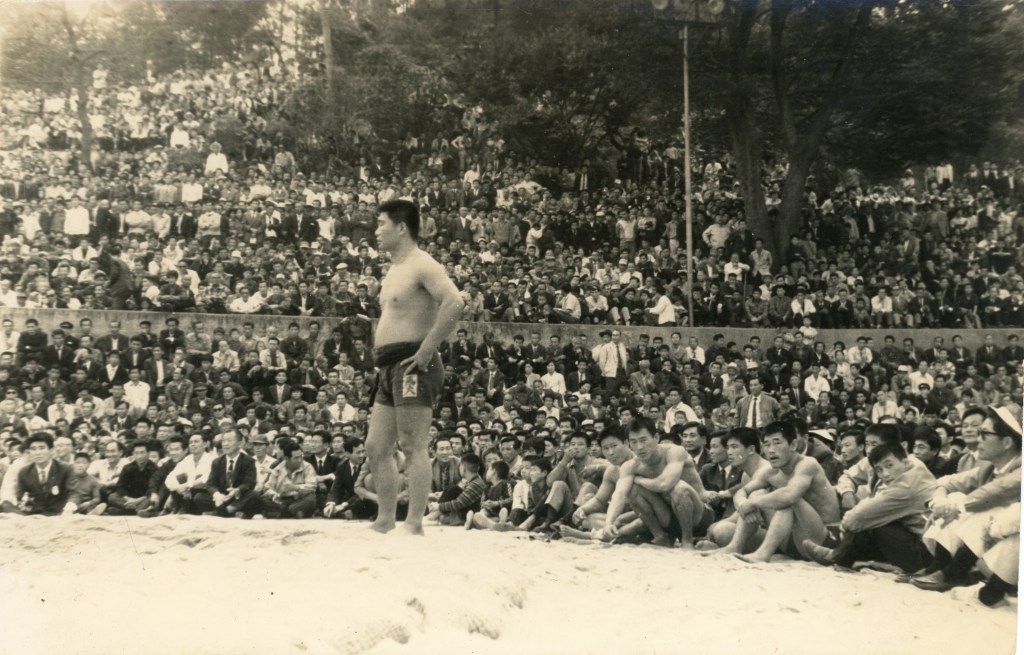

Kim Seong-ryul’s ssireum career truly flourished after he started college. In 1966, upon entering Masan University (now Kyungnam University), he began to dominate the Korean ssireum scene. That year, he won the individual college division at the Dano Festival Memorial Tournament, and he was the runner-up at the 20th National Ssireum Championship and the 1st Seoul Mayor’s Cup Ssireum Tournament. In 1967, at the Democratic Republican Party Chairman’s National Grand Champion Ssireum Tournament, he defeated prominent wrestlers like Park Du-jin and Kang Gi-young, claiming the championship. This victory marked the beginning of his dominance in the ssireum world, leading to his reputation as the undisputed champion across national competitions in the late 1960s.
When referring to official records, Kim Seong-ryul dominated nearly all national-level ssireum competitions in Korea from the late 1960s to the late 1970s. His victories were almost akin to a solo run. Specifically, Kim Seong-ryul’s championship tally included five victories at the National Ssireum Championship, three at the National Weight Class Ssireum Championship, eight at the President’s Cup National Grand Champion Ssireum Tournament, four at the KBS Cup National Grand Champion Ssireum Tournament, and three at the Chairman’s Cup National Grand Champion Ssireum Tournament. Remarkably, his records include winning streaks such as three consecutive championships at the National Ssireum Championship from 1972 to 1974, two consecutive titles at the National Weight Class Ssireum Championship from 1970 to 1971, eight consecutive victories at the President’s Cup from 1970 to 1977, four consecutive titles at the KBS Cup from 1972 to 1975, and three consecutive victories at the Chairman’s Cup from 1973 to 1975. These achievements illustrate that in the 1970s, it would not be an exaggeration to say that the ssireum sandpits of Korea existed primarily for Kim Seong-ryul, underscoring his unparalleled dominance in the sport.
The process of becoming a champion wrestler is fascinating, especially in the context of ssireum, where the beauty of the sport lies in the ability of smaller wrestlers to defeat larger opponents using their sash and technique. A notable example of national interest in this dynamic can be seen in the popular matches between Lee Man-ki and Lee Bong-geol following the launch of folk ssireum.
Similar to this, the final match of the KBS National Grand Champion Ssireum Tournament, broadcast nationally, featured Kim Seong-ryul against Park Beom-jo. This matchup was likened to a David versus Goliath battle, with many expecting the much larger Park Beom-jo to win. However, it turned out to be a miscalculation. Kim Seong-ryul defeated Park Beom-jo using an inside leg hook, securing the victory and demonstrating the unpredictable thrill of ssireum.
Kim Seong-ryul’s unexpected victory became a pivotal moment that sparked the popularity of ssireum in Korean society. This surge in interest was largely due to his matches being the first to be broadcast nationwide. His surprising win not only imprinted the excitement of ssireum and the presence of Kim Seong-ryul in the minds of the public but also served as a catalyst for increasing national interest in the sport.
Furthermore, when Kim Seong-ryul achieved an overwhelming 15-match unbeaten run to win the 3rd National Grand Champion Ssireum Tournament in 1974, more people began flocking to the sandpits to watch him compete, boosting his fame and the appeal of ssireum. Professor Lee Man-ki, the first ever Cheonhajangsa (a title for champions) from Inje University, recalls the process of Kim Seong-ryul’s matches, noting his dominant performance during this period.
Professor Lee Man-ki recalls visiting the MBC Culture and Sports Center in Jeong-dong, Seoul, as a child to watch Professor Kim Seong-ryul compete. At the time, Professor Kim didn’t immediately overpower his opponents. Instead, he connected with the audience, timing his moves to their countdown. As the crowd counted down from five to one, he would execute his move to overpower his opponent. Matches were either five or three minutes long, but around the four-minute-and-thirty-second mark, the countdown would start. “When General Kim would kick at just the right moment, his opponent would fall over. The crowd went wild,” remembers Lee Man-ki.
Kim Seong-ryul added excitement to ssireum. His inherent strength and flexibility, refined through technical wrestling, made this possible. Thus, Kim emerged as a unique figure in the ssireum world of the 1970s, and his performance directly contributed to the popularization of Korean ssireum. It’s understandable in this historical context that Kim Seong-ryul’s hidden contributions played a part in the emergence of folk ssireum in the 1980s.
We also needed to consider Kim Seong-ryul’s life as a wrestler, not just as a ssireum athlete. While his achievements as a wrestler may seem modest compared to his legacy in ssireum, his dual participation in both wrestling and ssireum, where he demonstrated exceptional skills, warranted a detailed examination. Some literature on Kim Seong-ryul mentions his wrestling accolades inconsistently without primary sources. Therefore, this research attempted to compile a record of his participation in national sports festival wrestling competitions. This approach helps clarify the extent of his involvement and success in wrestling alongside his celebrated ssireum career.
When referring to official records, from the 1970s through 1983, Kim Seong-ryul participated in the super heavyweight category of wrestling at the national sports festivals, where he won 16 gold medals, 4 silver medals, and 3 bronze medals. It is challenging enough for an athlete to achieve victories in their primary sport, yet Kim Seong-ryul displayed outstanding results in wrestling during his peak years in ssireum—a time when the wrestling field was relatively less competitive. This achievement highlights his versatility and exceptional talent as an athlete. Furthermore, it reveals his contribution not only to ssireum but also to the growth of wrestling in Korea.
Thus, Kim Seong-ryul, with his natural athletic abilities and competitive nature, played a significant role in popularizing ssireum in the 1970s while also enhancing the development of Korean wrestling. His contributions across these two sports make him a memorable figure who significantly influenced the trajectory of Korean athletics.
2.2. Activities for Ssireum After Retirement
After retiring, the activities Kim Seong-ryul engaged in for the advancement of ssireum are also pivotal in understanding the sport’s transmission process. The ssireum techniques Kim disseminated became vital nutrients fostering the growth of Korean ssireum, passing down his knowledge to future generations. His career as an educator significantly contributed to the emergence of ssireum talents in the Masan region. Notably, champions like Lee Seung-sam, Lee Man-ki, and Kang Ho-dong, who were instrumental in leading Korean ssireum from the 1980s onward, were all nurtured under Kim Seong-ryul’s tutelage. This fact highlights that his role extended beyond just being an athlete to being an educator as well.
The reason Kim Seong-ryul is called a hero of modern ssireum is largely due to his post-athletic career as an educator. He was one of the first ssireum athletes to transition to an academic life, becoming a university professor. In a time when it was uncommon for athletes to pursue academia, Kim, after graduating from Kyungnam University’s School of Commerce in 1972, could not give up his academic pursuits and went on to study at Kyung Hee University Graduate School of Education. He began lecturing at Kyungnam University in 1975 and served as a professor in the Department of Physical Education at Kyungnam University’s College of Education from 1983 until his death in 2004. Kim Seong-ryul has explained his choice to live as a professor in the following way:
Kim Seong-ryul elaborated on his motivations for remaining active in academia, “I might be the oldest active ssireum athlete. My involvement with the university is significantly motivated by a desire to foster younger generations, essentially aiming for the revival of ssireum. I wanted to show that a ssireum athlete can also be a university professor… to serve as even a small stimulus for the younger athletes who aspire to be ssireum players.”
This statement highlights his dedication not only to his sport but also to educating and inspiring future generations, bridging the gap between athletic and academic pursuits. Kim Seong-ryul chose to live his life as a university professor motivated by the desire to nurture future generations and provide a future for fellow ssireum athletes, moving beyond the traditional path expected of them. His decision also stemmed from a personal passion for academia. Becoming a professor, especially as a figure synonymous with the physicality of ssireum, represented a challenge against societal prejudices towards athletes and a personal battle as well. Despite the difficult circumstances, Kim Seong-ryul overcame these barriers and embarked on an academic career, contributing to sports literature by publishing papers and studies. His notable works include studies on the significance and characteristics of ssireum and comparisons of the physiques and athletic abilities of university ssireum athletes. These contributions highlight his dedication to both his sport and its academic study.
As an educator, Kim Seong-ryul found his greatest fulfillment in nurturing students, with Lee Man-ki being one of his most remarkable achievements. Lee Man-ki, the inaugural Cheonhajangsa (Grand Champion) and one of the brightest stars produced by Korean ssireum, grew under Kim Seong-ryul’s influence. Lee Man-ki’s introduction to ssireum in Masan, Kim Seong-ryul’s home turf, marked the beginning of their fateful relationship. Several newspaper articles and documents mention that Lee Man-ki received direct training in ssireum techniques under Kim Seong-ryul, leading him to become a grand champion.
In an interview conducted on August 31, 2021, Professor Lee Man-ki clarified his experience with Kim Seong-ryul, saying, “In fact, I don’t really remember General Kim Seong-ryul directly passing down ssireum techniques to me, as he wasn’t in a position to directly teach us at that time. There was also quite a significant age difference. However, I do recall grappling with him once or twice during high school. The feeling was like grabbing a mountain, similar to Mount Everest. At that time, General Kim was like a symbol to us. After all, it was after seeing him wrestle that we started practicing ssireum. He knew how to make ssireum appealing to people.”
This statement reflects the deep respect and symbolic influence Kim Seong-ryul had on younger athletes, even if he did not directly train them extensively. His impact on the sport and its practitioners was profound, inspiring a new generation of wrestlers by his mere presence and mastery of the sport.
Through interviews, it was discovered that Kim Seong-ryul’s direct influence on Lee Man-ki was not so much about specific coaching as it was about providing immense inspiration simply through his presence. Additionally, during his tenure as a professor at Kyungnam University, Kim Seong-ryul made regular visits to his alma mater, Masan Commercial High School’s ssireum team, to engage with and mentor the younger athletes. This was confirmed in an interview with Kim Jong-yeol: “About twice a week, he would visit the Masan Commercial High School ssireum team. He would don the sash himself and physically demonstrate techniques to the students. General Kim emphasized ‘big wrestling’ moves. He passed on his specialty, the ‘deulbaejigi’ technique, which involves using the stomach to bounce the opponent off. He stressed the importance of using the power from the stomach in combination with the arms and legs.”
This approach showcases Kim Seong-ryul’s hands-on involvement in nurturing and training the next generation, emphasizing the importance of physical demonstration and personal engagement in his teaching methods.
Kim Seong-ryul’s dedication to nurturing young wrestlers and preserving the tradition of Korean Ssireum was evident when he personally visited his alma mater, Masan High School, to teach and share his expertise. Particularly notable was his transmission of his unique skill, the “deulbaejigi” (lifting technique), demonstrating his sincere effort to cultivate the next generation of wrestlers and uphold the indigenous sport of ssireum.
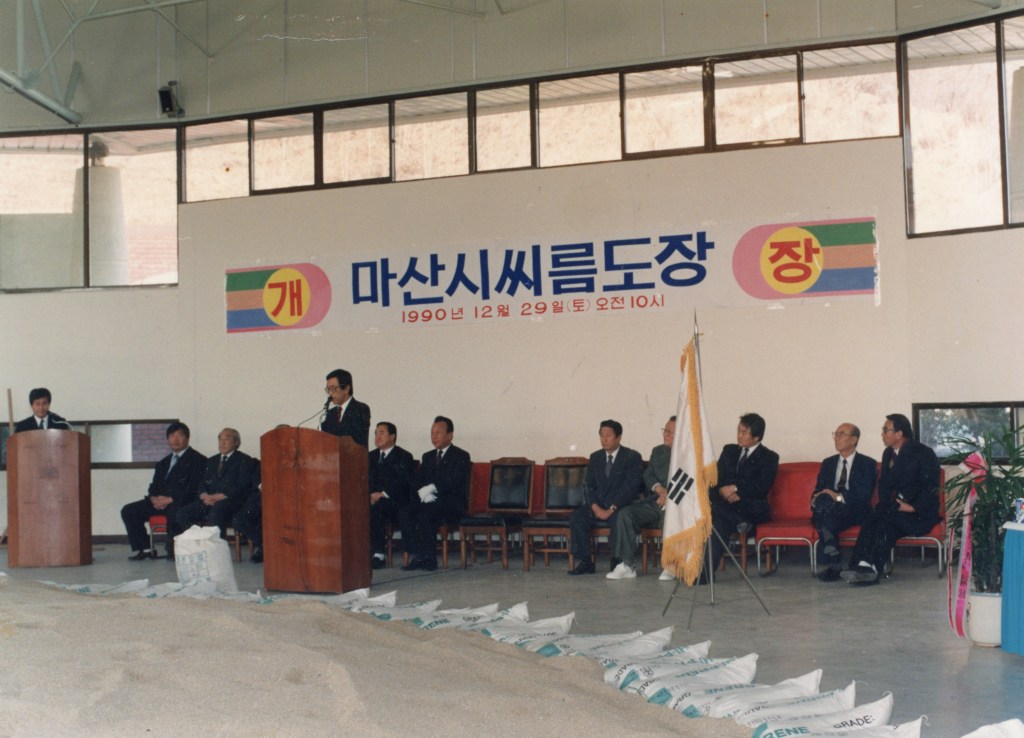
Kim Seong-ryul’s efforts in fostering ssireum talent are underscored by the establishment of dedicated ssireum gyms and the founding of the Masan Ssireum Team. Emphasizing the need for dedicated sports facilities to broaden the reach of ssireum, Kim Seong-ryul, with the support of local authorities and residents, saw the inauguration of the Masan Ssireum Gym in December 1990 at the entrance of the former Masan City Gyobang-dong Seowongok Park. This facility served not only wrestlers but also provided ssireum education for the general public. Following his retirement, Kim Seong-ryul took on the role of the inaugural director of the Masan Ssireum Gym, dedicating his energy and passion to the spread of ssireum and the development of future talents. Additionally, during his tenure as a professor, Kim Seong-ryul lamented the absence of amateur ssireum clubs in his hometown of Masan. Consequently, he actively pursued the establishment of such clubs to ensure the continuity of Masan’s ssireum legacy. As a result of his proactive efforts, the Masan Ssireum Team was founded in 2000, further demonstrating Kim Seong-ryul’s commitment to fostering ssireum talent and expanding its influence in the Masan region.
After retiring, Kim Seong-ryul also embarked on a path as an administrator for the development of Korean Ssireum. In particular, he was appointed as the Technical Director of the Korea Ssireum Association in 2003, where he advocated for the implementation of the ssireum promotion system. Throughout this process, he enthusiastically oversaw the classification of ssireum techniques, which had long been a challenge for the association. Additionally, serving as the Director of the Promotion Examination Committee, he was responsible for evaluating wrestlers for promotion and himself attained the highest rank of 9th dan. Furthermore, Kim Seong-ryul appeared to be dedicated to the professionalization of ssireum. For instance, while serving as the Chairman of the Professional Ssireum Committee and the Chairman of the Rules Improvement Committee, he made significant efforts to institutionalize ssireum, aiming to elevate folk ssireum not only as a traditional sport but also as a professional discipline. Kim Seong-ryul held a philosophy that ssireum, as a sport indigenous to Korea, was not only valuable in itself but also the best foundation for all sports training, surpassing even Taekwondo. He practiced this philosophy by striving for the institutionalization and revitalization of ssireum as an administrator in the ssireum community. Thus, even after retiring, Kim Seong-ryul continued to actively contribute as an educator and an administrative figure in ssireum. His educational activities facilitated the cultivation of ssireum talent and the expansion of ssireum’s reach, while his administrative efforts laid the groundwork for the development of Korean ssireum.
 HEAVENPINE